

FOOLISH LAB · CHIERI (TO)
One company. Six departments. One employee.
The Tanner. Seventy-five centimetres. Nobody hired him: he appointed himself.
Who he is
Nobody knows when he arrived. Some say after a night that ran too long, others that he was already there, under the carpenter's bench.
One day someone said that running that lab would take at least six people. The next morning the Tanner was there. Not six people: one, with six changes of clothes.
The world around him is real — red brick, white tables, wooden moulds. He is the one who is seventy-five centimetres tall, and he sees the same things from a different altitude.
One day
It's not a series. It's a Tuesday.
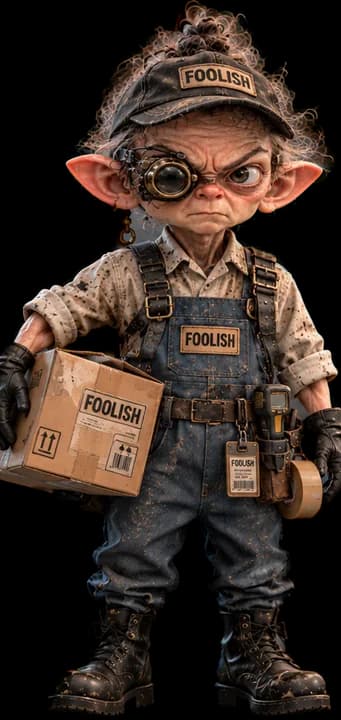 07:12
Warehouse. He unloads it, he signs for it, he complains about it.
 09:40
Secretary. Three emails, no answer. He wrote them.
 11:05
Call centre. "Your request is very important to us." True: he's the only one answering.
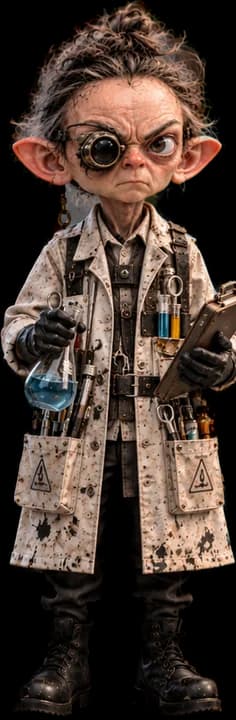 14:20
Chemist. The surface isn't even. He redoes it. Fourth time.
 16:45
CEO. Meeting with the departments. The departments are him.
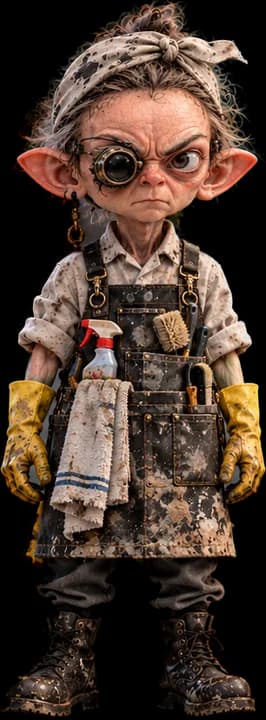 19:30
Cleaning. Someone left flock on the bench. That someone is me.
- 23:58
The light under the carpenter's bench is still on.
The lab
Five areas, all real: the white casting tables, the shelves of anatomies, the carpenter's bench under the window, the book-mould station, the steel prep bench.
Under the carpenter's bench there's a space that appears in no floor plan: a microscopic desk, a lamp, notebooks and a pile of sheets he hasn't approved yet.
And there are traces that aren't his. Sealed boxes, labels, finished orders. Someone produces here. No face. Necessary.
The paradox
He wants one thing: a perfect surface.
The problem is that perfect human skin doesn't exist. Uneven colour, different textures, variations in thickness: the very thing that makes a practice skin believable is what the Tanner calls a defect.
Coloured flock never distributes evenly — catalysis does what it wants, and that's where the variation that reads as real skin comes from. The pores aren't printed: they absorb the transfer and let the excess ink out. Colour isn't laid on top, it's deposited in layers: that's why the washes read, without anyone looking through them.
To the Tanner it's a personal insult. To a tattooer it's the reason it works.
What it has to do with you
The Tanner exists for people who do everything themselves. If you handle clients, orders, shipping and social media in the same day, his week will look familiar.
There's one difference: the skins leaving his bench are checked by him, piece by piece. Everything else — phone, courier, deadlines — he answers the way you do.